An interactive guide to how 1970s electromechanical pinball works, using Gottlieb's 1977 Solar City: relays, the score motor, steppers, score reels and chimes.
- Shipped
- Built with
- antigravity, gemini-4-neon
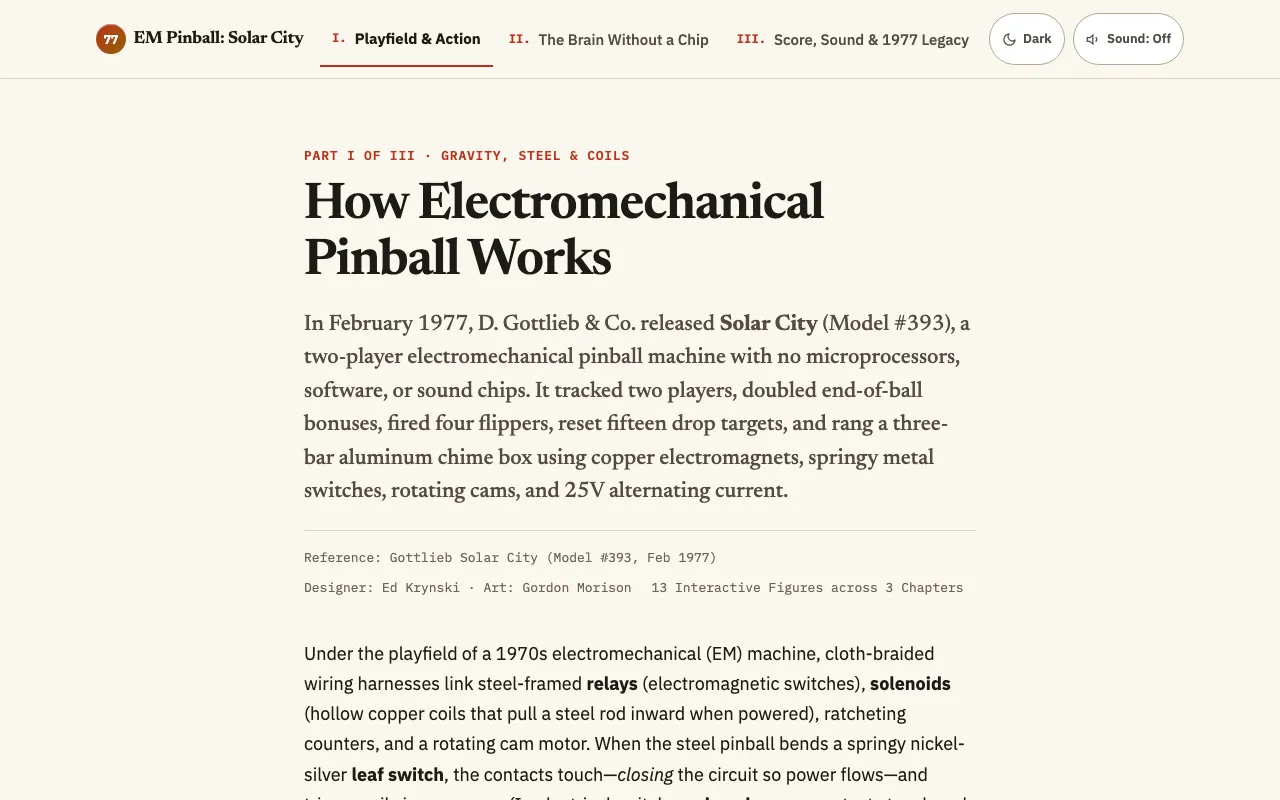
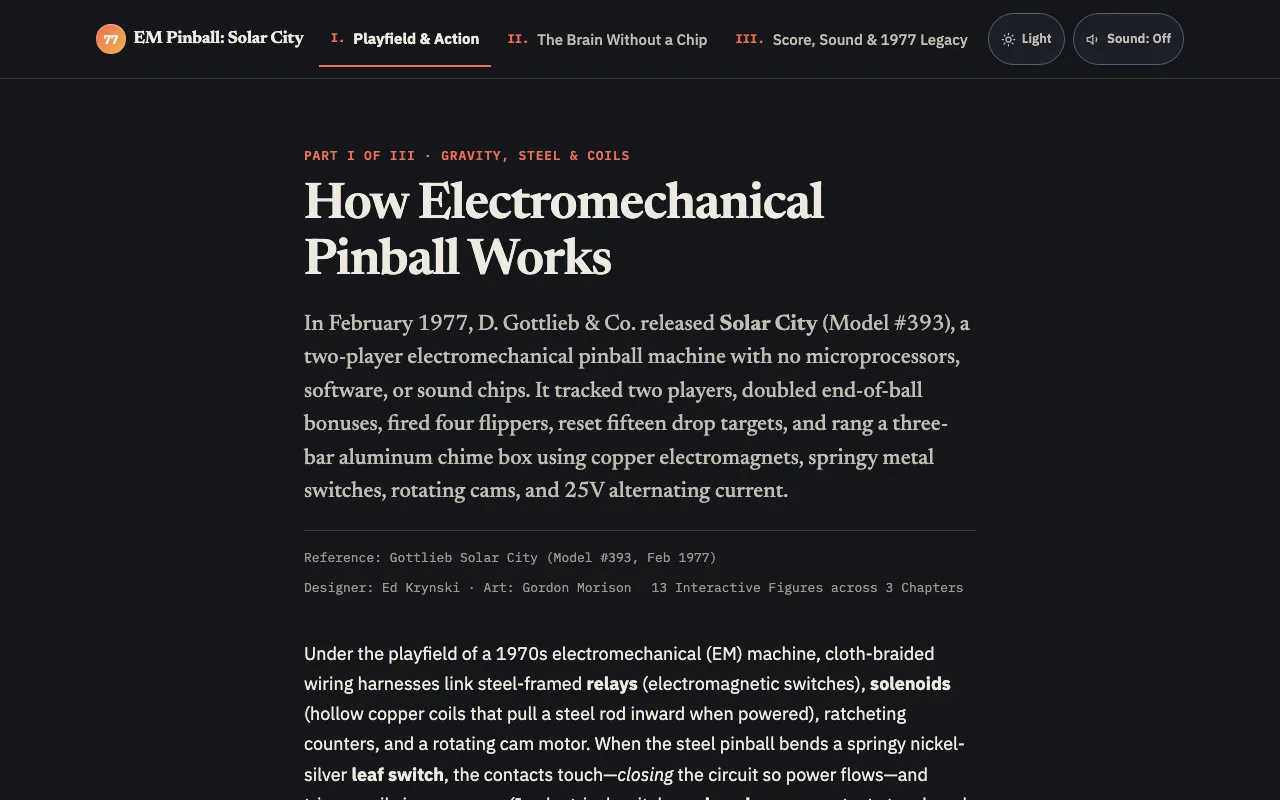
We’re buying a used Gottlieb Solar City, a two-player pinball machine released in February 1977, so it turns 50 in February 2027. It’s electromechanical: no microprocessor, no software and no sound chips. Before it arrives I wanted to understand how a machine like that runs a whole game on relays, coils, cams and 25V AC, so I built an explainer that uses Solar City as the worked example throughout. The writing reads much better thanks to Ricky Robinett’s No Slop Skills, which I used to review and rewrite it.
It’s three chapters with 13 interactive figures you can click or drag to operate each mechanism, plus optional synthesized relay clicks, solenoid clacks and chimes:
- Playfield & Action: the cabinet layout, the plunger and playfield pitch, flippers, pop bumpers, slingshots and Solar City’s 15 drop targets
- The Brain Without a Chip: the step-down transformer, relays as 1-bit memory, the score motor and the stepper units that track players, balls and bonus
- Score, Sound & 1977 Legacy: score reels and how they carry and reset to zero, the three-bar chime box, the 00–90 match unit and the machine’s history
How it was built
I built it on 24 November 2026 with the Antigravity CLI’s /swarm command, mostly on the Gemini 4 Neon model. The inspiration was an article on how a mechanical watch works, whose diagrams show the mechanism instead of just describing it. I asked for the same treatment for electromechanical pinball, and gave it a primer article plus a conversation I’d had about Solar City for the details.
The first draft explained things correctly but was a slog to read. A second pass with Ricky Robinett’s no-slop skill, also in Antigravity with Gemini 4 Neon, rewrote the text so it’s actually interesting to read.
It’s plain HTML, CSS and JavaScript with no build step, deployed to Cloudflare Pages, with light and dark modes.
What I learned
There’s no “brain” in a 1977 pinball machine, just a lot of very literal ones. A relay that wires its own switch back to its coil holds itself on, which makes it a 1-bit memory cell. The score motor is a timed sequencer that turns one switch hit into a spaced burst of pulses. The match unit doesn’t spin at game over: it steps along during play, and wherever it happens to stop is your match number. Knowing that should make the machine a lot less mysterious when it shows up and something inevitably needs fixing.
Prompts
1. The seed prompt
I love this article that shows how a mechanical watch works: https://martincmartin.github.io/slidev-stem/watches/article/1/
Is it possible to create a similar article as a static website in javascript/html/css that with information on how electromechanical pinball machines work? Especially the diagrams that go a long way towards showing rather than just telling how they operated. Here’s one article I found that has some information on them: https://retroonly.com/how-do-pinball-machines-work/
I particularly love Solar City from 1977 so I’d love to use that as a prime example. Here is a bunch of context about Solar City that could be useful as details throughout the website
I followed this with a conversation I’d had with ChatGPT about Solar City, which supplied the machine-specific details. The watch article set the bar: diagrams that show how the mechanism works instead of describing it.
2. Making the writing worth reading
Install the skills from https://github.com/rickyrobinett/no-slop-skills, then use the no-slop-readme skill to review and rewrite my README.md.
The first draft was accurate but dull. Ricky Robinett’s no-slop skill reviewed and rewrote the text so it’s actually interesting to read.