Pull apart a 3D roast turkey to compare breast, thigh, drumstick, wing and carcass, and what each is best for at dinner and in leftovers.
- Shipped
- Built with
- codex, antigravity, astra-6.2, gemini-4-neon
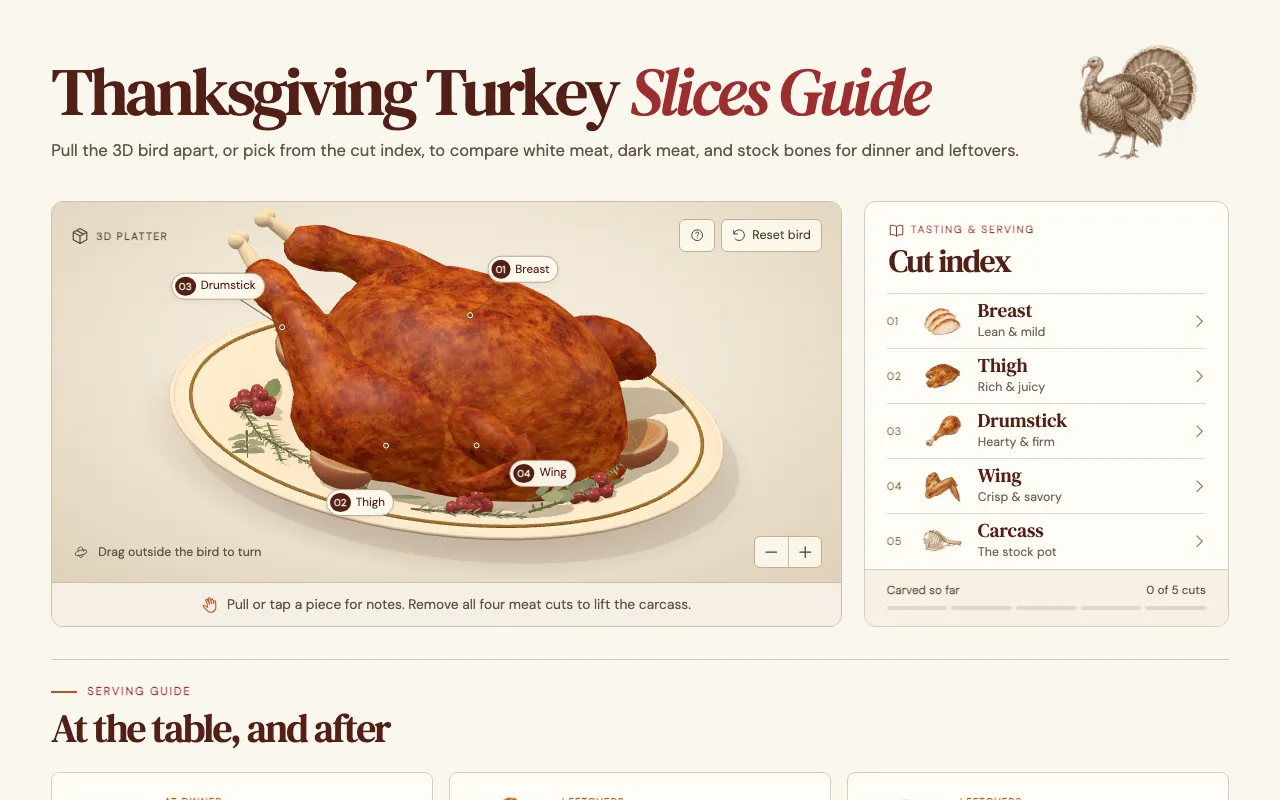
A Thanksgiving turkey isn’t one kind of meat. The breast is lean and mild, the thigh is rich and juicy, the drumstick is firmer, the wing is mostly crisp skin, and the carcass is what makes the stock. I wanted a guide that shows which piece is which and what each one is best for, at dinner and in the leftovers afterwards. The writing was reviewed and revised with Ricky Robinett’s No Slop Skills.
The main visual is a three.js roast turkey on a platter. Pull or tap a piece off the bird to read how it tastes, how to serve it at dinner and what to do with it later. Once all four meat cuts are off, you can lift the carcass for the stock pot. Below the bird, a serving guide pairs each cut with a dish: breast with gravy or in a next-day sandwich, thigh with stuffing or in a pot pie, drumstick in a morning hash, and the carcass and wing bones in turkey noodle soup.
How it was built
I started in OpenAI’s Codex with the Astra 6.2 model. I asked it to first come up with a list of ways to eat the turkey on Thanksgiving and afterwards, then build the three.js model to match, and gave it a color palette for the design. Then I switched to Google Antigravity with the Neon model and ran Ricky Robinett’s no-slop skill over the text in index.html. Back in Codex, a few short prompts cut things down: the title bar, the dinner and leftovers filter buttons, and an extra subtitle all went.
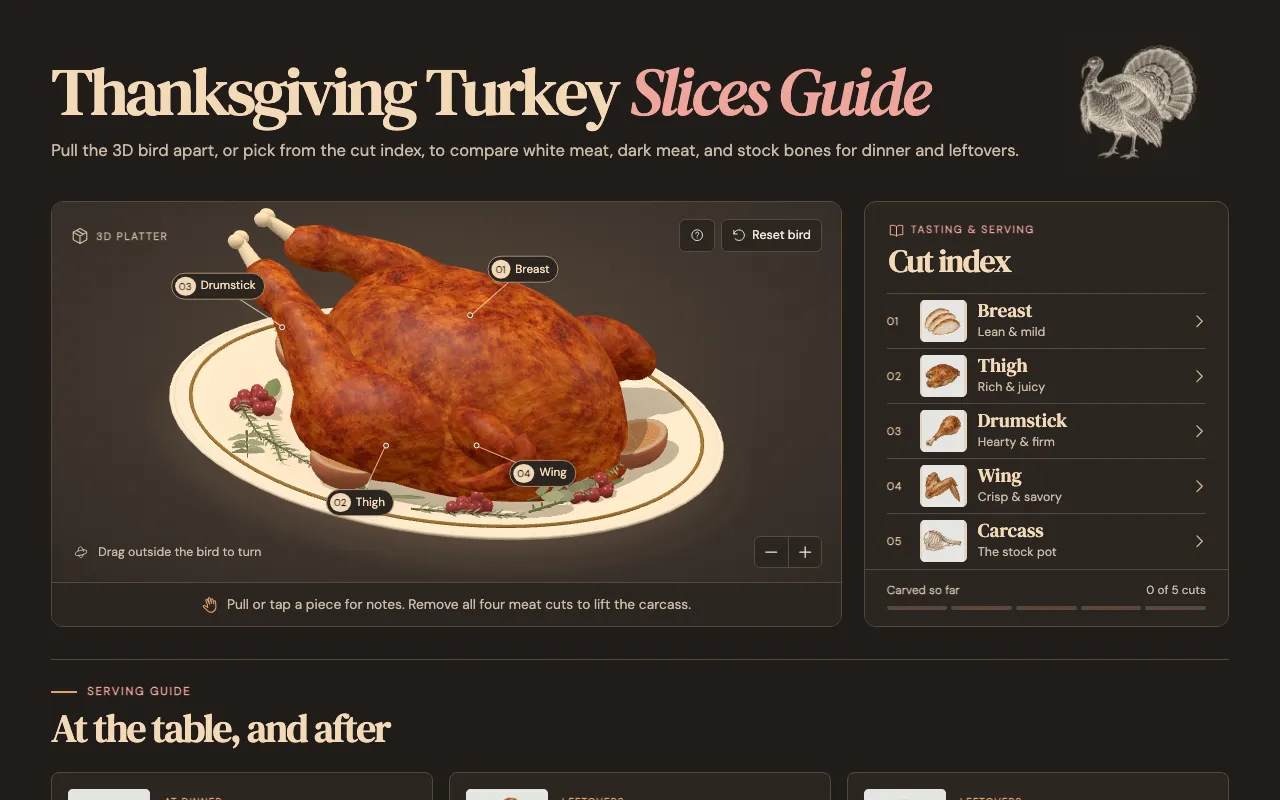
It’s a static site of plain HTML, CSS and JavaScript with three.js vendored in and no build step, deployed to Cloudflare, with light and dark modes and a switcher. The source is on GitHub under the Apache 2.0 license.
What I learned
Asking for the list of uses before the 3D model paid off, because the cuts you can pull off the bird line up with the serving guide below it. Most of the prompts after the first one removed things instead of adding them: for a one-page guide, less chrome made it better.
Prompts
1. The seed prompt (Codex, Astra 6.2)
Can you make a three.js model of a cooked Thanksgiving turkey that can be pulled apart, and when you take pieces of it off it will explain the differences in how the meat tastes and what it’s best used for (eat right away at dinner, save for turkey soup, next-day turkey sandwich, eat with stuffing, eat with gravy because it’s drier, etc.)? First come up with a list of ways to use the turkey and eat it on Thanksgiving or afterwards, and then create the three.js example to match. I’d like to deploy this as a static website with HTML/JS/CSS for Thanksgiving, so here’s the color palette to use in the website design.
This set the whole project up. Asking for the list of uses first meant the 3D cuts were built to match the serving guide. The color palette went along as an image.
2. A no-slop pass on the copy (Antigravity, Neon)
/no-slop-readme Rather than no-slopping the README, can you no-slop review and revise the text found in index.html? It is currently running on a local preview server as well.
I used Ricky Robinett’s no-slop skill on the page text instead of a README, with the site running locally so the agent could see it.
3. Drop the title bar (Codex)
Let’s remove the “Harvest Table” title and brown title bar to simplify, as it’s only one page.
4. Rename, and remove the filters
Also reword “Turkey, piece by piece” to “Thanksgiving Turkey Slices Guide”. Let’s also remove the “All, At dinner, Leftovers” buttons, no need to filter by those at the bottom. Remove “- Thanksgiving kitchen guide” before the main title.
Prompts 3 and 4 were about taking things out. A one-page guide didn’t need site navigation or filters.
5. Credit in the footer
At the bottom in the footer, instead of “Thanksgiving turkey guide”, have it say “Created by Matt Makai with OpenAI’s Codex with Astra 6.2, Google Antigravity with Neon”.